Someone commented that my book was a great book but that it needed an electronic version. I didn’t create an electronic version of the book for many reasons, and I want to share them with you. Most importantly, it would be a disservice to create an electronic bridge textbook, because readers don’t retain material from electronic books as well as they do from print books.

As an educator, my goal is for readers to learn. In case you doubt that hardcover books are better for learning, here are a few articles to consider:


– “Digital Versus Print: Which Mode Is Better for Learning?
– “Are Hardcopy or Digital Books Better?
– “The Case for Paper: Books vs. E-Readers
– “When reading to learn, what works best for students — printed books or digital texts?

Trying to absorb complicated material is different than reading a novel for pleasure. Perhaps if I were writing fiction, I’d consider having an electronic version. When reading a novel, it’s often fine to gloss over a few paragraphs here and there. As you can see from the articles above, textbooks are much better for recall and comprehension. If memory formation is the goal, then physical books are best. That doesn’t mean that digital books aren’t useful. For example, if I’m searching for specific information in a book, it’s convenient to do it electronically.

Another reason I didn’t offer my book in electronic form is that electronic books are much easier to pirate. Thieves can easily distribute electronic books for free all over the Internet, robbing authors of income. I spent a lot of money paying artists to illustrate the book and design the cover. If book bandits steal my book, I’ll never make enough money to pay the artists I had to hire. One author discusses this in an article entitled “Ebook Piracy Is Easy and Impossible to Stop Now.”

I make my books available to public libraries, where they can be read free legally. Librarians are usually happy to order my book for you if your local library doesn’t own a copy. There are other legal ways to read my book free. Many authors and publishing houses offer free copies of books if you agree to write an honest book review. Contact me if you’re a bridge player and might be interested in being part of my team of beta readers. Also, let me know what you think. Do you prefer a real book to an electronic book? Do you feel a hardcover book is the best format for a textbook? Should I offer an electronic version of my next book? I look forward to reading your comments.

Best,

Joanne

I’m So Grateful!

I recently learned that my book was named a top-rated runner-up in the Advanced Intermediate category at the 2024 American Bridge Teachers’ Association (ABTA) Book of the Year awards held in Canada. Those of you who know about all of the work that went into writing the book understand how much this means to me. My eyes were brimming with tears when I heard the news. Thank-you to the ABTA book selection committee for this great honor; it is wonderful motivation to continue the work on my next book.

My Book Found Its Way to the Land Down Under

I also learned that the book was acquired by the State Library Victoria in Australia, which obviously made me very happy. Some writers may wonder if it’s a good idea to make their books available to libraries where people can read them for free. What they may not realize is that there are thousands and thousands of libraries in the world that buy books. In the United States alone, there are approximately 123, 627 libraries, according to the American Library Association (ALA). When libraries purchase a book, it provides good exposure for the book. People who like the book a lot may want their own copies, and they’ll also look for future books by the same author. If you’d like to read my book but can’t afford to buy it right now, I understand. Please ask your local library to buy the book and add it to their collection. This can be as easy as filling out a “Suggest a Purchase” form online. I would love it if all of my blog readers would suggest that their local libraries purchase my book. Remember that university libraries purchase books, too, and they usually love to get book suggestions from readers. If you can’t find a form online, just check with the nice librarian. For the kind folks who purchased my book, I appreciate your support. If you’d like to purchase my book and haven’t done so yet, it’s available at Amazon and bookstores worldwide online.

Will You Help Me with a Little Experiment?

For those of you who are game, it might be fun to conduct a little experiment. Find the online “Suggest a Purchase” form for your favorite or nearest library. For example, the Baltimore County Public Library uses this form. Let me know in the comment section below if you were able to suggest a purchase of the book for your favorite library. Did you get a response? If you’re able to get a library to purchase my book, I’d really love to know about it. Authors can send letters and one-page sell sheets to librarians asking to have their books considered; however, as you might imagine, that can be an expensive and time-consuming process. It’s nice to get help from my friends.

Soon I’ll be sharing some information about my next book. I can’t wait until you see the cover. Right now, I’m busy editing like a mad woman.

Until next time,

Write something you love! — Joanne

WriteSomethingYouLove.com

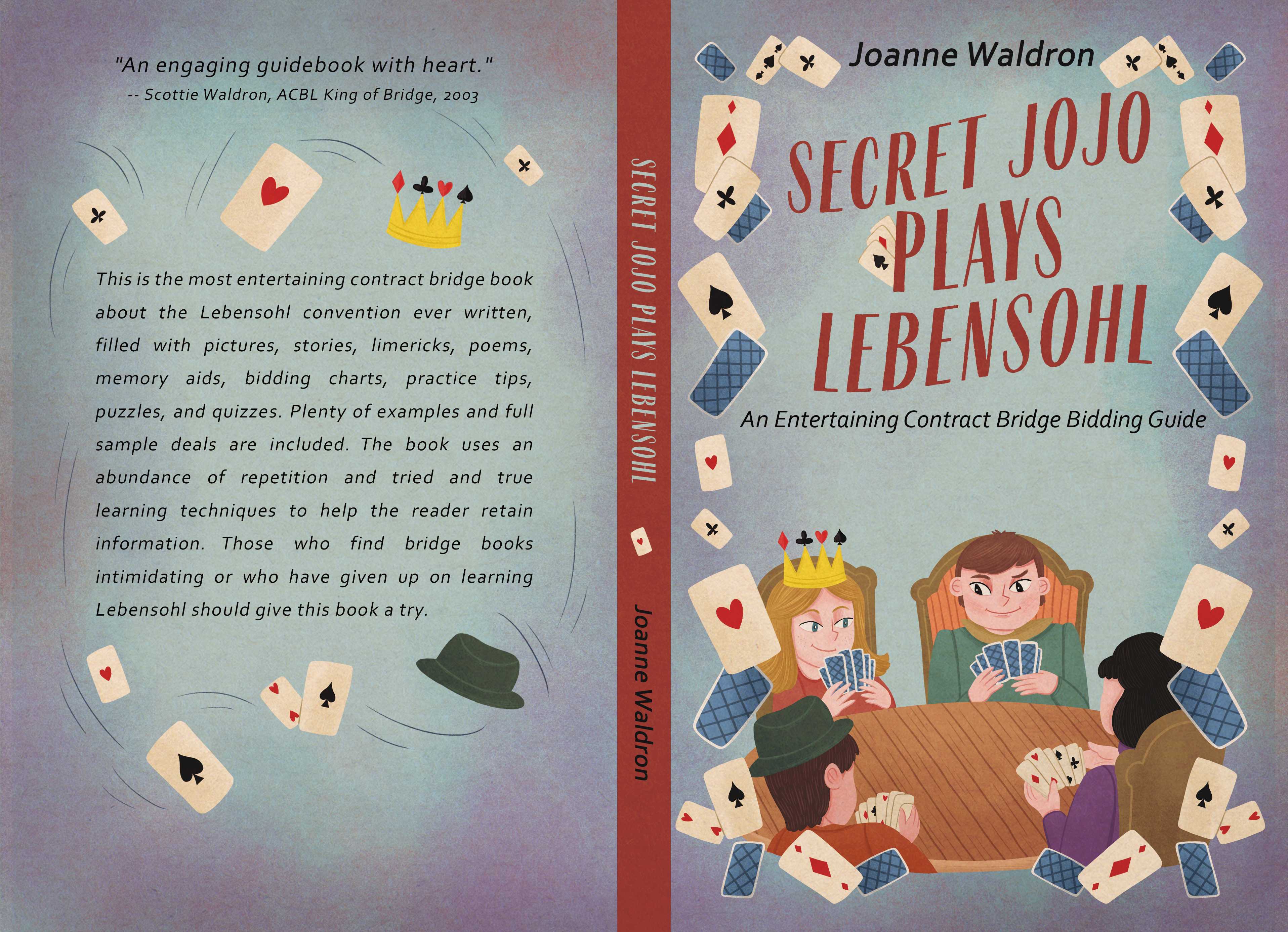
It’s been a while since I’ve posted, but I want to give you a sneak peek at the cover of my upcoming book. While this book is intended for bridge players, I would love to get your feedback even if you aren’t a bridge player. People do judge a book by its cover, and that’s why I decided to hire an artist to design the cover with a custom illustration. I’m quite pleased with it, and I’m glad I decided to hire a pro. I hope to share more book updates soon.

What do you think of my cover? Feel free to let me know in the comments below. Comments are moderated in order to maintain a friendly atmosphere.

Until next time,

Write something you love! — Joanne

WriteSomethingYouLove.com

character-woundThe hero in every story must face many obstacles before reaching his ultimate goal. Maybe a prince wants to save a princess from a fire-breathing dragon. Saving the princess is the external conflict. Once the external conflict is resolved, the story is over.

In the best stories, the obstacle within the hero (internal conflict) is the one he finds most difficult to face. The internal conflict has to do with the character’s belief system, which keeps him from reaching his external goal. Typically, the protagonist is tormented by a wound from his past, and this wound is something that happens before the story begins.  The protagonist usually doesn’t realize this wound is influencing his behavior. Maybe a prince watched his family burn in a fire when he was a child, but he needs to overcome his fear of fire to defeat the fire-breathing dragon and save the princess.

Using a Prologue to Introduce the Wound

Writers may wonder the best way to introduce a character’s wound. One way (not the best) to introduce a character’s wound is with a prologue. In the movie Twister, Helen Hunt plays the role of Dr. Jo Harding, who is a storm chaser. The movie begins with Harding watching her father being swept away by a tornado when she was a child. However, most movies don’t use a prologue to show a character’s wound. The wound is part of the character’s backstory. I often advise writers not to use a prologue to introduce a character’s wound. While a prologue is a convenient way for the writer to inform readers about a character’s past, most of the time, a prologue is not the best way to elicit an emotional response from a reader or viewer.

If I happen to watch or read a news report about a bus hitting someone I don’t know, it doesn’t matter in the same way that it would if that news report was about a bus hitting a neighbor or a friend. That’s why many writers opt to introduce a character and get the reader to care about that character before showing his wound. I recently critiqued a manuscript that began with a prologue wherein a child was struggling to save himself after a canoe overturned and his parents drowned. Of course, the child turned out to be the hero in the story. While I was reading the prologue, I kept thinking how much more effective the story could be if the writer would wait and add the backstory later. Sure, it’s always sad when a child is involved in a boating accident. However, it’s always easier to feel the pain of someone you know. It’s hard for writers to keep important information about their main characters to themselves, but nevertheless, wise writers play a waiting game before they skillfully let the story thunder rumble. They weave in the pieces of backstory in small bits. Imagine if the movie Silence of the Lambs had begun with a prologue showing what had happened to Clarice Starling as a child. It wouldn’t have been nearly as effective or exciting as Hannibal Lecter coaxing the information out of her.

Using a Flashback to Introduce the Wound

Flashbacks are another method writers sometimes choose to introduce a character’s wound. Story guru Michael Hauge admits in an interview with Film Courage that he’s “not really fond of flashbacks as a rule, especially to reveal wounds.” One movie that Hauge feels is an exception is Hitch. He explains:

But in that movie, it works I think because it’s such a funny flashback as well as touching, and it establishes such an important quality for the character of Hitch. Because we see when he was in college, he had his heart broken and that’s when he acquired the belief that if I fall in love with anybody, it’s going to lead to a broken heart. Which leads to his identity, his I’ll help everyone else fall in love but I don’t do that; that’s not for me.

Screenwriters and novelists pay Michael Hauge lots of money (hundreds of dollars an hour) for his advice, and I have no doubt that it’s worth every penny. The man knows how to tell a story. I would advise any writer to seek out his books, interviews, workshops, and blog posts. Hauge is clear in his assertion that in most cases, the writer does not want to announce a character’s wound at the beginning. There are always exceptions, but it’s more common not to reveal the wound until well into the story. Hauge notes that the movie Good Will Hunting is half over before the viewer learns about the abuse Will suffered as a child.

Using Dialogue to Introduce the Wound

So, how does a good writer reveal a character’s wound? Michael Hauge offers writers this advice in the interview with Film Courage:

One of the most effective ways to reveal the wound is through dialogue. It’s oftentimes more powerful to hear about a wound that a character suffered than to watch it on a screen.

In the movie Fifty Shades of Grey, the viewer learns that Christian Grey was horribly abused as a child when he confesses his past to Anastasia during an intimate moment, well into the movie. It would’ve been a nauseating experience for movie viewers to have to watch a child being abused onscreen. It’s a much more moving experience for the viewer to piece things together as information is slowly revealed through dialogue. Writers are often told to show rather than tell, and this is good advice much of the time. However, readers and viewers of most types of fiction take no joy out of reading about or watching children suffer. However, it’s always satisfying when, in an emotional moment, a character confides in another character about his past.

Let the Reader Make Inferences About the Wound

In some stories, the wound is never clearly stated. After all, it’s most important for the writer to know what the character’s wound is. The writer has to know the backstory for the hero well enough to understand what wounded him in the past that made him the way he is in the present. Although it may be tempting to use prologues and flashbacks to introduce character wounds,  it’s almost always better to wait and introduce the wound through dialogue.

What do you think? Feel free to let me know in the comments below. Comments are moderated in order to maintain the spam-free,  family atmosphere.

Until next time,

Write something you love! — Joanne

WriteSomethingYouLove.com

Readers AskQUESTION: What’s the problem with opening a novel with dialogue?
Answer: I prefer not to open with dialogue, but there are writers who do it successfully. Most people are familiar with Charlotte’s Web by E.B. White (you know, the White who coauthored The Elements of Style, Fourth Edition with Strunk). The first line of White’s famous book is etched in my memory:

“Where’s Papa going with that axe?” said Fern.

In the case of Charlotte’s Web, the opening draws the reader into the story, right into the middle of some exciting conflict. However, it’s risky to open with dialogue when the reader has no context for what is taking place. Similarly, it’s chancy to open with a character’s thoughts (interior monologue).

If an opening makes a reader feel disoriented, (s)he might not continue reading. Although some authors get away with opening a novel with dialogue, it’s better to introduce the characters and setting first. If a character speaks before a reader knows anything about the character, the reader may form an image that is different than the author’s. Then, as more details about the character come to light, it could be quite jarring to the reader if he is forced to change his mental image of that character. Some readers even create voices in their heads when they read dialogue. Imagine a reader’s frustration if he has to recreate a character’s voice.

There’s nothing like a real-life example. Suppose for a moment that you’re a single woman at a party. Some guy you’ve never met walks up to you and says, “Let’s get out of here.” That line will certainly get your attention but maybe not in a good way. Now consider the same scenario, except that a friend introduces that guy as the Chief of Neurosurgery at a well-known hospital before he tries to whisk you away. Maybe you still wouldn’t want to leave with him, but you might decide to steer him to the punch bowl. Dialogue means nothing without proper context.

Until next time,

Write something you love! — Joanne

WriteSomethingYouLove.com